Tuesday, March 18, 2008

Rare Mummified Dinosaur Uncovered


I think its funny that in spite of the evidence that this dinosaur was covered rapidly (hello, think major flooding) to create its fossilized skin, the scientists INSIST it is 65 million years old. When will they learn?

Rare mummified dinosaur uncovered
Duckbilled Edmontosaurus covered by fossilized skin that is as hard as iron
By Blake Nicholson
The Associated Press
updated 8:06 a.m. MT, Tues., March. 18, 2008


BISMARCK, North Dakota - Using tiny brushes and chisels, workers picking at a big greenish-black rock in the basement of North Dakota's state museum are meticulously uncovering something amazing: a nearly complete dinosaur, skin and all.
Unlike almost every other dinosaur fossil ever found, the Edmontosaurus named Dakota, a duckbilled dinosaur unearthed in southwestern North Dakota in 2004, is covered by fossilized skin that is hard as iron. It's among just a few mummified dinosaurs in the world, say the researchers who are slowly freeing it from a 65-million-year-old rock tomb.
"This is the closest many people will ever get to seeing what large parts of a dinosaur actually looked like, in the flesh," said Phillip Manning, a paleontologist at Manchester University in England, a member of the international team researching Dakota.
"This is not the usual disjointed sentence or fragment of a word that the fossil records offer up as evidence of past life. This is a full chapter."
Animal tissue typically decomposes quickly after death. Researchers say Dakota must have been buried rapidly and in just the right environment for the skin to be preserved.
"The process of decay was overtaken by that of fossilization, preserving many of the soft-tissue structures," Manning said.
read the whole article here

Wednesday, March 5, 2008

School Outings

We went to the library one day and did our studies in a study room while Daddy worked at home. Convenient!


Alex did his science fair project on Diamonds and we got to go to the fair. It set our minds a reeling.

We got to go to the Phoenix Zoo on the Saturday after we finished wild animals. Zebras, kangaroos, elephants... but no penguins.

Why Tax Credits Are Wrong for Homeschoolers

by Valorie Delp

Qualified educators currently can claim $250 on qualified purchases from the IRS. Most homeschoolers spend at least that on curriculum per year so why not give us a $250 tax credit too? I could use that money!

Who Defines a Home Educator?

I think I'm pretty safe on this one. You see, I'm sure I'm a home educator. I have curriculum. I have paperwork. I have my little teacher's card from HSLDA and most reasonable businesses give me their teacher discount. New York State requires so much paperwork that I can use any of the paperwork that I turn in to 'prove' that I'm teaching.

My friends in Connecticut or New Jersey though, they don't have any requirements. What would they use to prove that they're home educators? Their child's portfolios? And what about my unschooling friends? Because their educational philosophy disagrees with mine--do they not count as home educators?

The first problem with accepting tax credits is that it necessarily means that the government must define who is a home educator and who is not. Do you really want that? It would likely mean federalized paper work, specific type of record keeping, and a set course of instruction. . .which brings me to my next point. To be honest, I don't see how the federal government could possibly require more paperwork than I already do, but most homeschoolers in other states could not say the same thing. Chances are good that if you're reading this, a tax credit would increase your paperwork, and probably substantially.

Who Defines What Qualified Expenses Are?

Having the government define what my qualified expenses are for home schooling makes me squeamish to be honest. I don't want the government involved in my home schooling--period. While I'm sure I could prove I'm a home educator I'm less sure that my curriculum would be approved, as it's decidedly Christian. And people who use Bob Jones or Abeka….they could forget about being approved, as that curriculum is all from one view point. Do you want government approved curriculum? If you do, you might want to consider sending your kids to public school. That's fine by me. . .it's your choice. But I don't want the government letting me know whether or not phonics is okay and what I'm allowed to teach in science.

And let's talk about other 'curricular' items. I know a family who decided to put a chicken coop in their backyard. I can see how that's home schooling. . .do they get a tax credit for that or does that not count? What about my kids' classes that they take at the Y? Do those count? Those are on their IHIPs. And again, our unschooling friends who don't use any curriculum. What could their qualified expenses be?

Accepting the tax credit means that the federal government will have to define who is a home educator and what is a qualified expense. It might not seem that complicated on the outset. But remember that it's the state government, and not the federal government that currently decides on state education laws. Shifting the power to define who we are and what we teach will not only increase government control in home schools, but it could easily infringe on the rights of parents to teach their own children at home. I know personally, I cannot support increased government involvement in home schooling and so I'm happy to forgo a tax credit.

Special Request

I mentioned in the Barometer that I have started some speech therapy with Huyler. Let me explain. Huyler has been an avid finger sucker since he was a baby. He still is. We have tried to break the habit, but to no avail. Anyway, it seems like Huyler’s inability to say his /R/ sounds may be partially due to this habit. But now Augie, who has never sucked his fingers, is having the same problem! Is he learning it from Huyler? I don’t really know! So, I hunted around a little to try to find some speech therapy techniques to use in helping him say it properly. There wasn’t a whole lot available without spending lots of money. I found some articles on teaching English as a second language to Japanese people, who often confuse /R/ and /L/ sounds. I’m using that information to try to teach him the proper tongue position for /R/, but the problem is, he doesn’t confuse it with /L/, but with /W/. I know this is a really common speech impediment, so there must be something more specific to his needs out there. I thought I would just ask each of you to keep your eyes peeled for materials, articles or techniques that could help us out. You got to feel for the kid, when he can’t even pronounce his own name properly!

More Precious Than Silver

Here are Huyler and Ardara singing along with Satellite Soul on "More Precious Than Silver". Again, I looked up the signs for the words on ASLpro.com so there may be a better way to do the song in sign, but I love how much heart the kids put into this. Maybe some day they will be able to tell a deaf person about the Lord from learning all these signs.

J is for Jewels


For our week on Jewels, we started off by learning about Jewels—how they are formed, how they are mined, and how they are cut to catch light so they will sparkle. We learned about some interesting things like the work of a “lapidary”, the UN warning against buying “blood diamonds” used to fund wars, and about making synthetic diamonds in a laboratory. According to Alex’s science fair project, they are now making diamonds out of peanut butter! We also got to see a real emerald, a real garnet, and a real opal that Grandpa Mark sent us. One day, we examined my diamond ring, and looked for the tiny flaw in it with a magnifying glass. Huyler found it but Ardara had to be shown. We read a book called “A Cache of Jewels” to learn about collective nouns, or words that describe a collection of things (school of fish, kindle of kittens, etc.) We also used little jewels to do some of the math worksheets that Grandpa John passed on to us from his horde of teaching materials (notice the collective noun). We made jewel necklaces out of colored straws. We made crowns out of foil. And most importantly we made rock candy! Our parallel lesson was that Jesus is more valuable than anything else. Our next post will be a video of the kids signing “More Precious Than Silver” and doing the sign language with it. One more rare rock we read about this week was meteors /meteorites.

R is for Rock


I think we had the most contributions ever for the next two lessons. Grandpa Mark sent us the most awesome rock collection. We can’t wait to show it off to the boy next door who keeps his rock collection in a used pizza box. We also loved the presentation that Uncle Ammon sent about different kinds of rocks and how they are formed. It went perfectly with what we learned from library books and our curriculum. We spent our first day looking at these great collections, and read a book called “The Magic School bus Goes to the Middle of the Earth” in which we learned a bit more about how rocks are formed—from magma, heat, pressure and time, just like Ammon said! The second day, we went outside and collected rocks of our own. We tried to find varied shapes, sizes, textures and colors. Then we came inside and sorted them by color, by size, by texture, etc. The next day, we went back through them and sorted them by metamorphic, sedimentary, and igneous. We also tried to grow our own crystal garden using salt, water and liquid bluing on sponges. I don’t know what we did wrong, but instead of growing up, like I have seen them do, they spread far and wide, all over the outside of the dish, the tray it was sitting on and even a little on the window sill! Yikes! But they did grow…


We also checked out a DVD of “Journey to the Center of the Earth” with Pat Boone. Classic.
Our lesson from the Bible was to “build our lives on the Rock,” Jesus Christ. We read the parable of the wise man and the foolish man. We even tried building with blocks on a big rock and in the soft dirt next to it and then flooding the houses with a whoosh of water. Sure enough, the house that wasn’t on the rock toppled and the house on the rock stood firm. We learned about builders using a “plumb line” to build their house, and using the same parable, we decided that the plumb line we follow for our lives should be God’s Word.


STOLEN!

Imagine our excitement when Monday morning we read the headlines of the huge art heist in Switzerland! The four paintings stolen at gunpoint were by Cezanne, Degas, Van Gogh and Monet and were worth over $163 million!!! We looked up pictures of them online. One of them we had already looked at in our Impressionism lesson on Friday. We sure do hope they catch those bad guys before those paintings are sold on the black market or damaged!

Read More

But things really got out of hand when we finished our week on J is for Jewels and saw an article about a jewel heist! We are afraid to study anything else of value, for fear that there is some connection between our studies and the thefts. Could Ardara and Huyler be high-profile cat-burglars on the sly?????

Read More

Impressionism


During our first week of February we learned about Impressionist art. We read a book about artists like Monet, Renoir, Pissarro, Degas, Cassatt and Van Gogh. We learned how they used broad brush-strokes, varied textures of paint and modern themes to create the impression of something, rather than a realistic image of the subject. Since this was also our week on Kangaroos, we read a book called “Animals Should Definitely Not Wear Clothing”. So, our most contemporary experience was the idea of animals getting all tangled up or inconvenienced by their clothing. This birthed the concept for our art project. We decided to do a painting of an animal having some difficulty with an item of clothing, and to paint it in an Impressionist style. Ardara painted a monkey trying to wear overalls, but the strap was caught on a branch, so he couldn’t swing free. Huyler painted a bunny trying to get into a shirt (in the lower right). All the swipes and slashes across the page show the struggle this little bunny has had getting into a blouse that is much too big.

Z is for Zebra


Zebra week was just too fun. We learned about these ungulates (members of the horse family) from several library books. We were surprised at how big the plains zebras get—actually measuring 6 feet high at the shoulder! We looked at a picture of a zebra and drew the stripes on a blank zebra as closely as possible to the markings we observed. Then we painted tall, brown grass in front of them and saw how the stripes could be good camouflage for a zebra. This tied in our biblical lesson for the week, “I can’t hide anything from God.” We read Psalm 139, Psalm 33:13 and Hebrews 4:13 as some examples of how much God sees. We are so glad to know that our outer hurts and our inner feelings are all just as important to God, and he sees it all as plain as day, even if we keep it a secret from other people. We took a break on the 13th to make Valentines using some fun craft ideas from Anika. Then on Thursday, we went back to the concept of continents and countries. We practiced naming all seven continents and all 4 oceans. Then we made an awesome mural of Africa with pictures of many wild animals that are exclusive to Africa. We looked in an encyclopedia to figure out what part of the continent they would be found on. Like our ocean mural, this took a lot of work, but was also very fun and gratifying! Some other fun games we played were hide and seek and Wild Animal 20 questions, which Ardara is now addicted to. And we finished off the week and our entire wild animal section with a surprise trip to the Phoenix Zoo! See our School Outings post for photos.

K is for Kangaroo


Kangaroos are really special. We had no idea how many different kinds of Kangaroos there are. The ones we usually see in movies and on TV are Giant Red Kangaroos, but there are over 50 different kinds of kangaroos, and many other kinds of marsupials (animals with pouches). We learned about life cycles of the kangaroo—did you know that a baby kangaroo is only the size of the tip of your finger when born, and the little grub-like baby has to climb up its mother’s fur to crawl into her pouch? - and we learned about the way kangaroos eat, defend themselves, play, etc. One day we went outside with a measuring tape and took turns seeing how far we could hop. The farthest hop was Ardara with 4.5 feet. Then we measured 40 feet, the length of a single hop by a Giant Red Kangaroo! Pretty amazing. We watched videos of kangaroos boxing, playing on the beach and climbing in trees (a different species than the hopping kangaroos). We made kangaroo pouch pencil cups out of frozen juice cans (see our School outing post) We also discussed Australia—learning the difference between a country and a continent, and how Australia is BOTH, as well as being an island, which we learned the definition for. We made the chart of “Animals that Hop” which you see here. And our words to remember when we see a Joey tucked in a pouch are “God keeps me safe”.

Wednesday, February 13, 2008

High school calls all 2,550 students to detention


Just another reason I'm glad I home school...


PALM BAY — An accidental push of a button Friday had students at Palm Bay High questioning what they'd done wrong and parents plotting punishments.
Parents of all 2,550 students in the school received an automated call Friday reminding them that their student had to report for Saturday morning detention. Problem was, the message only should have gone to 16 homes.
"One of my friends texted me to ask if I had Saturday detention," said Robert Lenoci, 15, of Valkaria. The sophomore is going to the state science fair finals and hasn't been in trouble before.
"I looked and I had a message from mom. She was asking, 'What did you do?' It was pretty bad," he said.
Robert's mother calmed down after talking with other parents and learning something was amiss.
Amy Stewart said after the call that she confronted her son, Jimmy, and he pleaded innocent.
"He said he didn't do anything, but I took him Saturday morning anyway," she said. About 40 students showed up.
That's when Stewart and dozens of other parents learned of the glitch.
"I had yelled at him. I felt so bad, I took him out for breakfast," Stewart said.
Steve Muzzy, assistant superintendent for information technology, said the parent notification system purchased about six years ago from Synrevoice Technology of Canada averages 20,000 calls a week.
He said half are for student absences and the rest for things such as overdue library materials, school calendar events or for emergency communications.
"Very, very rarely do we run across any problems. This was an unfortunate human mistake," he said. School officials said an employee apparently selected the wrong field, sending the message to all students.
Principal John Thomas said by the time the error was discovered, it was 9:30 p.m. and too late to call everyone. But he did send an apology via the system during the weekend.
The 7 to 9 a.m. detention on Saturdays has been in place for some time, for such infractions as repeatedly being late for class. But the automated system has been used for notification for only about two months.
Stewart just wants to make sure there is no suspension on her son's school record.
"I would hope there wouldn't be," she said.

Tuesday, February 12, 2008

What about Socialization?!

Adapted from an article by Robin Sampson

If only homeschoolers had a nickel for every time they heard the question, "... but what about socialization?" That infamous socialization question, for any seasoned homeschooler, is quite a humorous one! Although non-homeschoolers worry that homeschooling may turn children into social misfits, we know that the opposite is true and that POSITIVE socialization is one of the best reasons to home school your children.

Most home school families I know are very active with other families. There are weekly field trips with support groups, twice-a-week church functions, scouts, choir, weekly skating parties, etc, etc.

But don’t take my word for it. Let us look at the home school statistics.

Studies Prove Homeschoolers Do Better Socially
Information gathered by the National Home Education Research Institute prove home school students have significantly higher self concepts than those in public schools.

Dr. Johnson (1991) concluded that home educators carefully address the socialization needs of their children in every area studied (i.e., personal identity, personal destiny, values and moral development, autonomy, relationships, sexuality, and social skills).
Studying actual observed behavior, Dr. Shyers (1992) found the home educated had significantly lower problem behavior scores than do their conventional school age mates. And the home educated have positive self-concepts.
Dr. Taylor (1986) found that the home educated have significantly higher self concepts than those in public schools.
The home schooled are well adjusted socially and emotionally like their private school comparison group. The home educated, however, are less peer dependent than the private school students (Delahooke, 1986).
Dr. Montgomery (1989) found that home schooled students are just as involved in out-of-school and extracurricular activities that predict leadership in adulthood as are those in the comparison private school (that was comprised of students more involved than those in public schools).
Home educated children are more mature and better socialized than are those sent to school, according to Thomas Smedley’s personal interaction and communications approach to understanding socialization.
Dr. Gary Knowles, of the University of Michigan, explored adults who were home educated. None were unemployed and none were on welfare, 94% said home education prepared them to be independent persons, 79% said it helped them interact with individuals from different levels of society, and they strongly supported the home education method.

What Does God’s Word Say About
Socialization?
The concept of separation from evil is fundamental to God’s relationship with His people. According to the Bible, separation has more than one dimension:
· Separating yourself morally and spiritually from sin and everything that is contrary to Jesus Christ and his word. (Ephesians 5:11)
· Drawing near to God in a close intimate fellowship through dedication, worship and service. (Psalm 4:3)
· Retaining a position in the world where we can serve as salt and light to unbelievers. (Matthew 5:13-16)

We are called to live lives of separation, protecting our children from the teachings and pitfalls of the world. And yet, we are called to train our children to love and reach out to the lost world around them. This requires a careful balance of preparing their hearts in the safety of their home, but also of providing them opportunities to interact with people from all walks of life. Because of the more frequent interaction they have with adults, homeschooled children are being socialized in the most relevant ways.


Cuisenaire Math Rods


For every letter we study, we do a page with math rods. The kids are asked to “Build the P with rods of all different colors.” and then “Which colors did you use?” or “Build the P with only one color” and so on. They then color the P where the rods are placed and cover each color with the single-unit white rods. In this way, they find the numeric value of each different color. This gives them practice with whole number addition and multiplication concepts. They are also learning that more than one number sentence for the same sum can be generated.

Penguins and Icebergs


This is a video of the kids playing in the bathtub with our homemade "icebergs". We froze water in ziploc baggies in various shapes. Then we cut the ziplocs away and dropped the ice in cold water. We used water balloons as "penguins" and let them slip around on the ice and slide into the water! We also watched some slide shows on youtube about icebergs. I'll add one of them next so you can see some cool pictures of icebergs that we liked a lot. Click here to see the page where we learned all our iceberg info. We actually learned a lot about icebergs, more than I put in the Barometer because of space issues! The videos on the web page are cool, but there are sooo many youtube videos about icebergs.


http://www.youtube.com/watch?v=G7vZAJ...
http://www.youtube.com/watch?v=cJ8NkN...
http://www.youtube.com/watch?v=YcQeZLsqCQo
http://www.youtube.com/watch?v=%20iIT5MLt7JOU

E is for Elephant


Our week on elephants was a lot of fun. We started out by reading a book called “Elefriends” that told about the sad plight of these huge animals being poached for their tusks. We learned how very smart and sensitive elephants are. We also learned that elephants remember other elephants for many years even if they don’t see them for a long time. They communicate with low rumbles that carry over many miles when they are not together! Because of the adage that “an elephant never forgets”, our biblical parallel was to always remember what God has done for us. We did some exercises in counting our blessings and remembering the times when God has answered our prayers. We studied the anatomy of elephants and the areas—Africa and India—where elephants are found. We watched videos of elephants on Youtube.com where we learned about the rarely observed jungle elephants that are very different from elephants on the savanna—their tusks grow straight forward to help them not get caught in the dense trees! We also learned about elephants that eat rocks rich in salt. They have actually grazed the same rocky area for a hundred or more years and created a huge cavern system! We wanted to visit a zoo this week, but it didn’t end up being a good week for it. We aren’t TOO disappointed because we have ridden elephants two years in a row at the Rennaissance Festival. So, we are waiting for warmer weather for a zoo day!


We watched lots of youtube videos of circus elephants doing tricks and then the kids pretended to be circus elephants in their masks. Ardara made peanuts out of paper (a time consuming project) and we did a circus show for Daddy. Click here for a slide show.


P is for Penguin


The final week of January, we took a trip to Antarctica to study Penguins. Okay, we didn’t really go to Antarctica, but it did snow again in Prescott! We learned about five different species of penguins: Gentoo, Macaroni, Adelie, Emperor and Chinstrap Penguins. Much of our focus, though, was on the Emperor penguin and the love shown within their family unit. We watched the March of the Penguins. Then we discussed how God wants us to show love to everyone, especially our family. We also learned about icebergs. We made our own miniature icebergs and floated them in the bathtub. For a cute video of this, see the next post. We got sick toward the end of the week, so we used our extra week of January for more art appreciation and penguin activities, including painting penguins and flashcards of types and locations of the world’s penguins.

H is for Horse


We started off horse week by learning about different breeds and uses of horses through history. We discussed horse training and how a horse needs to be “broken” before they are used by farmers or racers, etc. Once a horse it broken, it is one of the most obedient of all domestic animals. Our words to remember were “I obey right away” according to verses like Col. 3:20 “Children obey your parents in everything, for this pleases the Lord.” The next day, we made a comparison chart between horses and cars which showed what ways they are the same and what ways they are different. We figured out that the reason horses are being replaced by vehicles more and more is because vehicles can work hard without getting tired or hurt. If they do get hurt, it isn’t as sad, because they aren’t living creatures. We got to walk over to our neighbors’ pasture with some carrots and feed the horses through the fence. These horses really like us. We have fed them sugar cubes before, so they were willing to brave the mud to get close to us! We also made horse sculptures out of clay. We watched “My Friend Flicka” with Roddy McDowell . And we had a “treasure hunt” where the kids had to obey my instructions perfectly to find the prize. Then we discussed how we can miss out on wonderful surprises from God if we don’t listen to him and obey him.

C is for Cow


Continuing the study of domestic animals, we started the year off with cows. Most specifically, dairy cows. We read several books about dairy farms and how they operate. From milking machines to homogenization. On the second day, we put cream in a jar with a clothes pin and shook until it turned to butter. Daddy was especially impressed by this trick. I had told him about it, but evidently he was skeptical until he actually saw it with his own eyes! We gathered up props to help us remember the nursery rhyme “Hey, diddle diddle!” and each of us took a turn holding up the props and saying the rhyme. It was interesting to me that the kids would learn the story easily, but then try to tell it without considering the rhyming aspect of it. They would all finish up with something like “And the dish and the spoon ran away together.” But after several tries, they got it right. We created a list of foods made from milk, and then went shopping. On the last day, we had a dairy party. We had kefir to drink, we ate baby cheese with crackers, creamy Swiss with grapes, cottage cheese with cucumbers, and string cheese. Followed by ice cream bon bons for dessert! We read stories about how ice cream is made and how mozzarella is made. We discussed how milk helps us grow. In 1 Peter 2:2-3, God’s Word is compared to milk that helps us grow spiritually. So, our words to remember were “God’s Word helps me grow”.
One library book we found about cows was called “The Cow who Fell in the Canal” and it took place in Holland. We found Holland on the globe and went through the book pointing out things that were uniquely Dutch. Then we learned about Pieter Brueghel, a Dutch painter from the 16th century. Then, the kids each tried to duplicate one of his paintings from memory.

Monday, January 7, 2008

Charlotte Mason in a Nutshell


By Deborah Taylor-Hough
Discover an education revolutionary who loved God and children.

taken from a web page called A Charlotte Mason Education

A Charlotte Mason Education -
Charlotte Mason was a big thinker who had a very high view of children. So let me start out by saying that I don't believe anyone could ever fit Charlotte Mason's ideas, methods and philosophies into an actual nutshell (I just thought it made a good title for this article). Miss Mason's ideas were so broad and far reaching, it took six large volumes to contain her writings on just the topic of education. With that said, here's a very brief overview of a handful of Charlotte Mason's most familiar ideas.

TWADDLE:
Twaddle is what parents and educators today might call "dumbed down" literature. It is serving your children intellectual happy meals, rather than healthy, substantive mind- and soul-building foods. Charlotte Mason advocated avoiding twaddle and feasting children's hearts and minds on the best literary works available.

LIVING BOOKS:
Living books are the opposite of dull, dry textbooks. The people, places and events come alive as you read a living book. The stories touch your mind and heart. They are timeless.

WHOLE BOOKS:
Whole books are the entirety of the books the author actually wrote. If the author wrote a book, read the whole book. The opposite of this would be anthologies that include only snippets from other works—maybe a chapter from Dickens, a couple of paragraphs from Tolstoy, etc.

NARRATION:
Narration is the process of telling back what has been learned or read. Narrations are usually done orally, but as the child grows older (around age 12) and his writing skills increase, the narrations can be written as well. Narration can also be accomplished creatively: painting, drawing, sculpting, play-acting, etc.

SHORT LESSONS:
Charlotte Mason recommended spending short, focused periods of time on a wide variety of subjects. Lessons in the early years are only 10-15 minutes in length, but get progressively longer as the children mature. (Lessons increase closer to an hour per subject for high school students.)

NATURE WALKS:
In spite of often rainy, inclement weather, Charlotte Mason insisted on going out once-a-week for an official Nature Walk, allowing the children to experience and observe the natural environment firsthand. These excursions should be nature walks, not nature talks.

DAILY WALKS:
In addition to the weekly Nature Walks, Mason also recommended children spend large quantities of time outside each day, no matter what the weather. Take a daily walk for fun and fresh air.

NATURE NOTEBOOKS:
Nature Notebooks are artist sketchbooks containing pictures the children have personally drawn of plants, wildlife or any other natural object found in its natural setting. These nature journals can also include nature-related poetry, prose, detailed descriptions, weather notes, Latin names, etc.

ART APPRECIATION/PICTURE STUDY:
Bring the child into direct contact with the best art. Choose one artist at a time; six paintings per artist; study one painting per week (maybe 15 minutes per week). Allow the child to look at the work of art intently for a period of time (maybe five minutes). Have him take in every detail. Then take the picture away and have him narrate (tell back) what he's seen in the picture. Excellent prints can be viewed and purchased from the National Gallery of Art.

JOURNALING:
There's great value in keeping a personal journal, encouraging reflection and descriptive writing. Record activities, thoughts and feelings, favorite sayings, personal mottoes, favorite poems, etc.

COPYWORK:
Daily copywork provides on-going practice for handwriting, spelling, grammar, etc. Keep a notebook specifically for copying noteworthy poems, prose, quotes, etc.

DICTATION:
Each day choose a paragraph, or sentence, or page (depending on the age of child). Have the child practice writing it perfectly during his copywork time. Have them look carefully at all punctuation, capital letters, etc. When the child knows the passage well, dictate the passage to the child for him to recreate the passage.

BOOK OF THE CENTURIES:
A Book of the Centuries is a glorified homemade timeline; usually a notebook containing one or two pages per century. As children learn historical facts, they make notes in their book on the appropriate century's page about famous people, important events, inventions, wars, battles, etc.

FREE-TIME HANDICRAFTS:
Charlotte Mason's schools finished daily academics in the morning, allowing the afternoon hours for free time to pursue crafts and other leisure activities or areas of personal interest.

HABITS:
Charlotte Mason had much to say on establishing good habits in children. Habits (good or bad) are like the ruts in a path from a wheelbarrow going down the same trail again and again. As time goes on, it becomes increasingly difficult to run the wheelbarrow outside the rut, but the wheel will always run smoothly down the well-worn rut in the path. By training children in good habits, the school day (and home life in general) goes more smoothly. Focus on one habit at a time for 4-6 weeks rather than attempting to implement a long list of new habits all at once.

Deborah Taylor-Hough is a wife and mother of three as well as a freelance writer, the editor of the Simple Times Newsletter and the author of the bestselling book Frozen Assets: How to Cook for a Day and Eat for a Month; and the new release A Simple Choice: A Practical Guide to Saving Your Time, Money and Sanity.

Beethoven Lives Upstairs


We have been listening to different classical music almost every week, but most of our focus has been on Ludwig Van Beethoven. I happened on this terrific movie at the library about the little boy in whose house Beethoven rented a room as he wrote his ninth symphony. It not only gave us some insight into Beethoven’s life and personality, but it put the master’s most famous work in a context that the kids could relate to and understand. Ardara was in tears as we watched the last scene, where Beethoven is conducting the symphony and he can’t hear the audience right behind him giving a standing ovation, so someone from the orchestra has to physically turn him around to see that the symphony was a success.
Along with the video was an interactive DVD-Rom that had games teaching notes, games teaching music dynamics such as piano, staccato, forte and so forth. The kids loved it. I knew it had really taken root when Ardara was using Jarnli’s computer on Christmas with Jake DeWester and the Disney page they were on started playing Moonlight Sonata. Ardara called out from the other room “Mom! This is Beethoven!” How many six-year-olds recognize Beethoven without prompting?

The Number Cup


The Number Cup is part of the children’s introduction to Math. Each week we learn a new number and practice writing it. One day each week, they take turns drawing a number from the number cup. Next, they take the corresponding number of beans out of the bottom of the cup. They write down the number on their page and then draw the correct number of objects. Every week they each draw two numbers to practice this way.

The Legend of the Three Trees

A story of Sacrifice

G is for Goat

Our section on domesticated animals started off with goats. We looked at information about different breeds of goats and the useful ways that people use goats. We tried goats milk (the boys liked it, but Ardara and I thought it tasted too musky) and we used soap made from goat’s milk. We learned about cashmere and angora and kid leather. We did puppet shows of “Old MacDonald’s Farm” for each other, made a matching game with baby animals and their mothers, and even played Simon says with farm animal sounds.
The parallel lesson from the Bible was looking at sacrifice. We learned about the temple sacrifices of the Old Testament, and how Jesus’ perfect sacrifice replaced those imperfect symbols. We learned what “sacrifice” means, and discussed why sacrifice is necessary for the forgiveness of sins. We realized together how much Jesus must love us to make such a huge sacrifice for us. Our words to remember were “Jesus died for my sins”.
It was really special that this chapter came right before Christmas. We watched a little video called “The Legend of the Three Trees” which went along nicely, and we also read a story called “The Trees of the Dancing Goats” about a Jewish family during the scarlet fever epidemic, who sacrificed their special Hannukah toys to make pretty Christmas trees for all their sick Christian neighbors.

Ant City (1949)

A good video about how ants live. Better than an ant farm (but we will still make an ant farm this spring)!

I is for Insect

Our week on insects was a little disappointing. We were supposed to make an ant farm, and I had the idea that I wanted to make our own and not buy one. I didn’t realize that we would be on this chapter in December. There aren’t any ants anywhere! Luckily, we were still able to “Learn a lesson from the ants, you sluggard!” as commanded in Proverbs 6:6-9, by looking on Youtube.com at an old movie from 1949 called Ant City. It was very informative. We also read all about ants and how they live.
We used one day to study ladybugs, where our story “The Grouchy Ladybug” taught us to tell time as well as sequencing from smallest to biggest.
Another day was devoted to bees. We got a real honeycomb and examined it to see what the hard work of the bees can result in. Then we read a book about a diligent bear and a lazy bunny who both plant gardens. One works hard and enjoys the fruit of his labors and the other barely even tries and wonders why he gets no produce. Then we read 2 Thess. 3:10 that says “Whoever will not work, should not get any food.”
Our last day, we caught a moth to observe and identify body parts on (the only live insect we could find) and we read a book about an inch worm and did some measuring.
Obviously, our lesson learned from insects was that we should work hard. This lesson couldn’t have come at a better time, when the kids have been doing a lot of whining and complaining about their chores. It seemed to turn a few lights on that hopefully won’t burn out soon!

Water, Water Everywhere! by Sally Cheney

Guinevere lay on her tummy on the pool side lounge, her chin resting on her hands at the foot end, and her legs bent to rest up against the back. She was concentrating on a puddle of water flowing slowly from under the lounge toward the edge of the pool, coloring the grey tile of the pool deck a darker shade of grey as it flowed along. The puddle, she knew, was from water dripping off her body. She had been playing in the pool, practicing swimming underwater, and was proud to have been able to make it all the way across the pool to the other side without having to come up for a breath. But it had taken many tries before she succeeded, and now she was tired. The sun felt so warm and nice on her back as she rested on the lounge!
Guinevere and her brothers, Lance and Arthur, were visiting at Aunt Katie and Uncle Ted’s home in Florida for Christmas. It was going to be a very different Christmas from what they were used to back in the West, where sometimes it snowed on Christmas. At least there was cold, frosty weather back home, even if it didn’t always snow. What would it be like to sing Christmas carols wearing shorts, on a balmy evening? Guinevere was hoping it would still be Christmas-y, but she wasn’t sure it could be!
Suddenly a yell of “Wahoo!” shattered her thoughts and the silence, as Arthur cannon-balled off the edge of the pool right next to her lounge, and sent a shower of chilly water over her! Guinevere sighed at the interruption and rolled onto her back. She could hear Aunt Katie’s sprinkler hissing among the flowers nearby and turned her head to watch the sun sparkle on the spraying droplets. As she watched, the shining droplets became dull as a shadow passed in front of the sun. Guinevere looked up to see a big black rain cloud darkening the sky! “Bang!” went a thunderclap! Guinevere sat up quickly and called to Arthur and Lance, “Get out of the pool! There’s a storm coming! There might be lightning!” Just then “Crack!” went a flash of lightning! She saw Lance grab Arthur’s arm and both boys flew up the steps out of the pool and raced into the house, grabbing their towels on the way.
They stood drying off by the big patio windows, watching as huge raindrops quickly painted polka dots all over the pool deck, and then the entire patio was awash with rain. “Wow! That sure happened fast!” exclaimed Lance, a look of amazement on his face. “How could it be so warm and sunny one minute, and pouring rain the next? This doesn’t happen in Arizona!”
“Welcome to Florida!” sang Aunt Katie. “Get dressed and we’ll play Scrabble for awhile.”
Guinevere stood under a hot shower rinsing off the chlorine from the pool, shampooing her hair, watching the sudsy water circle around and around as it went down the tub drain. “Water to swim in, water to grow flowers, water raining down on us, water to wash in,” she whispered to herself. “What would we do without water? It’s everywhere!”
As they gathered around the Scrabble board, Arthur wrinkled his nose and said, “What’s that yukky smell?”
“Oh my gosh! The potatoes!” cried Aunt Katie, jumping up and running to the kitchen. “Oh no! They’ve run out of water and now they’re burned! Guess we’ll be having macaroni and cheese for dinner tonight!”
“So that’s what happens without water!” thought Guinevere with a smile. “Dinner burns!” And she added “Water to cook with” to her mental list of uses for water.

The next day was December 24. Christmas Eve! Guinevere always got excited as Christmas morning neared, as she wondered what presents she would get for Christmas. She got out of bed and went to sit in front of the little nativity that Aunt Katie had arranged on the coffee table. She picked up the tiny figure of Baby Jesus from his little straw-filled bed. “I know Christmas is all about you,” she whispered, “but its fun to think about presents, too! And you are still the best present of all.” She kissed the tiny forehead and placed the Baby back in his bed. Then she moved Mary and Joseph a little closer to their Holy Child. She missed her own parents. They had decided to celebrate their wedding anniversary this December by going on a special Christmas cruise. That’s why Guinevere, Lance, and Arthur were staying with Aunt Katie and Uncle Ted. The cruise ship sailed from Florida to some tropical islands, and while Guinevere was happy that her parents were able to go on such a nice vacation, she missed them. What would Christmas be like without her parents? As she pictured her parents happily sailing out over the ocean, Guinevere realized here was another use for water: sailing cruise ships! As she thought about Christmas morning without her parents, tears began to slide down her face. “Oh great” she thought, sadly, as she wiped away the tears. “More water!”
Uncle Ted came into the room in his robe and slippers. When he saw Katie looking a little forlorn, he sat down next to her and put his arm around her shoulders. “Feeling a little lonely, Sweetie?” he asked as he hugged her close. “Maybe missing your folks just a little bit?”
“Yes”, Katie replied as she lay her head against Uncle Ted’s shoulder. “But I’m glad they got to go on the cruise. They’ve been talking about it for a long time.”
“Well, don’t you worry, we’re going to have a great Christmas ourselves! Your Aunt Katie and I learned long ago that Christmas may not be the same in Florida as it was in Arizona where we grew up, but people manage to make a happy Christmas wherever they are!”
“Make a Christmas?” Guinevere asked. “What do you mean make a Christmas?”
“I’ll show you! Come in the kitchen!”
“Back home in Arizona your family makes Christmas by doing the things that you all love to do every year, like putting up the tree, opening the little doors of the Advent Calendar, bundling up and going caroling, going to the church party. All those things are how you make Christmas with your family. Today Katie and I will show you how we make Christmas here at our home, in Florida!”
Uncle Ted opened the freezer and got out a can of frozen cranberry juice. Then, from the refrigerator he brought out a can of whole berry cranberry sauce and some yogurt. “We’ll start with our favorite Christmas breakfast!” he smiled. Grabbing the blender, he scooped in some yogurt, some cranberry juice concentrate, and some cranberry sauce. At the sound of the blender whirring, Lance and Arthur came running down the stairs.
“Katie!” called Uncle Ted. “Better get down here! The troops are starving, and you’re the Christmas waffle expert!”
There were a few moments of hustle and bustle as Katie arrived and started mixing something in a big bowl, Lance and Arthur set the table, and Guinevere was put to work chopping up fresh cranberries, oranges, and sugar in a big bowl. Finally everyone sat down at the table and bowed their heads as Uncle Ted thanked the Lord for His love that they were all feeling around them. He asked that Guinevere, Lance and Arthur’s parents be blessed with a wonderful, happy time together on their cruise. And he thanked the Lord that he and Katie could have “three wonderful children to bless our Christmas this year!” It was then that Guinevere realized that since Uncle Ted and Aunt Katie had never had children of their own, this was a special Christmas for them! In fact, much to her embarrassment, as soon as the “amen” was said, Arthur exclaimed, “Hey, how come you guys don’t have kids?” Something told Guinevere this was not something one should ask someone, even if one was curious to know! But Arthur was too young to realize that!
Aunt Katie and Uncle Ted didn’t seem to mind the question though, and Ted replied, “Well Arthur, the Lord hasn’t seen fit to bless us with children, for reasons of His own. That’s why we are so happy to have you three here with us this Christmas! Christmas is so much more fun when we can watch children enjoy it!”
Just then Katie brought to the table a big platter of RED and GREEN waffles! “Merry Christmas, everybody!” she laughed as she set the platter down in the middle of the table. Putting a green waffle on Arthur’s plate, she scooped up a big scoop of the sauce Guinevere had made, and plopped it on the waffle, topping it with whipped topping, and then, she even sprinkled the whipped topping with green and red sugar sprinkles! Uncle Ted filled each person’s glass with the cranberry smoothy mixture, and stuck a sprig of mint on top.
“Wow!” said Lance, as he took a sip, leaving a foamy mustache on his upper lip.
“Whoopee!” said Arthur, as he dug into his green waffle.
Guinevere glanced at Uncle Ted and he winked at her and smiled.

That night they all piled in the van and headed to the beach. Uncle Ted had promised a surprise. The children couldn’t imagine what could take place at the beach on Christmas Eve, especially in the dark. Lots of people had gathered to sit on blankets, glowing lanterns casting a pretty glow. Children were running around with Glo-sticks, laughing and playing. Suddenly a loudspeaker started playing Christmas carols out over the beach, filling the air with music. Everyone seemed to turn their heads at once, looking down the beach. Out on the water there was a beautiful sight making its way in the direction of the spectators. “It’s a fire engine! A fire engine in the water!” shouted Arthur, jumping up and down with excitement. “No, wait! It’s a fire boat!” he shouted. “Look! It’s spraying its hoses straight up in the air like a fountain!” It was true! The fountains of water sprayed high up from the sides of the fire boat, and the spray was lit up by green and red lights shining up from the deck. The fire boat tooted its horn and sounded its siren and everyone cheered. Behind the fireboat came dozens of wave runners, decorated with lights, looping and swerving and sending up their own sheets of spray! Behind the wave runners came small boats of all kinds with lights all over them. It was a glorious sight, as the colored lights reflected on the water! Guinevere had never seen a Christmas parade like this one! And then, at the end of the parade of boats came a big yacht, all covered in beautiful lights. And there was Santa Clause, sitting right on the bow, waving at the boys and girls on the beach! Suddenly beautiful fireworks filled the sky and “Jingle Bells” came over the loud speaker. Families joined hands and danced together on the sand as they laughed and sang with the music!
Gradually, the crowd became quiet, and Guinevere could see one more light coming across the water. A beautiful star appeared, formed of white lights. It was supported on a simple flat barge, towed by a little boat without any decorations. The lighted boats had all gone on and disappeared, and the only light left was the beautiful star. In the reverent silence, a voice came gently over the loud speaker: “As we travel to our homes tonight, let’s remember what Christmas is really about.” A lovely choir was heard, singing “Silent Night” as the star passed slowly by.
Later, after getting into their pajamas, everyone gathered in the living room. Uncle Ted asked Guinevere to light a little candle in front of the nativity. She guessed that Daddy had told Uncle Ted that this was a special tradition the children were used to, at home each Christmas Eve. Then the children snuggled up next to Uncle Ted and Aunt Katie, just the way they did with their parents every Christmas Eve, and watched the light of the little candle flicker on the nativity scene while Uncle Ted read the Christmas Story from the Bible, just the way Daddy did every Christmas Eve. It wasn’t exactly the same as home, but Guinevere knew Aunt Katie and Uncle Ted were trying to make it feel familiar for the children. And she knew her parents, far away on the cruise ship, were hoping their children were having a happy Christmas without them. Guinevere could feel the love her parents had for her and the boys.
As Uncle Ted tucked Guinevere into bed that night, he asked, “Well, Honey, how do you like the way we make Christmas around here?”
“It’s beautiful!” smiled Guinevere. “Thank you, Uncle Ted! Merry Christmas!”
As Guinevere lay in bed remembering all the fun of Christmas in Florida, she thought to herself, “I never would’ve guessed that with all the things we use water for, we could use it for making Christmas, too!”

W is for Water

December began with a study on water. We talked about how much of the earth’s surface is made up of water and all the forms that water is found in, from seas and lakes to glaciers to rain, snow and dew. We learned that water is necessary for all known life forms to survive.
We took a day to examine the properties of liquid. We poured water from one container to a differently shaped container and observed how it changes its shape to fit whatever container it is in.
Another day was spent examining solids. We found out that the freezing point for water is 32 degrees Fahrenheit. We put an ice cube in a glass in the window sill and one in a glass in the fridge and compared how quickly they melted back into liquid.
Thursday we learned about vapor or gas. We learned that the boiling point of water depends on the altitude. It is a higher temperature the lower you go. We read about the first hot air balloon and how the idea was conceived. Did you know that the inventor actually thought it was the smoke that was causing it to rise? Later it was discovered that hot air is lighter than cold air and that is why it rises.
On Friday we made a chart of Liquid/Solid/Gas and drew pictures of items that belonged in the various categories. We also had fun experimenting with what things would dissolve in water.
Our Biblical parallel this week was from John chapters 4 and 7 where Jesus tells us that anyone who asks will receive Living Water for their spirits. We talked about how our spirit can thirst for God and that Jesus gives our spirit the only thing that will quench that thirst—the Holy Spirit.


Thank you to Grammie Sally for writing us another awesome story, called “Water, water everywhere” for our week on water! Anyone who wants to read it, see the next post!

Thursday, November 29, 2007

Deep Sea IMAX - Jelly Fish

This wasn't our favorite part, but its the only clip I found on youtube! I would have shown you the Great Pacific Octopus eating a crab...

IMAX Deep Sea Adventure


Day four of Octopus week was supposed to be an ocean outing - visiting an aquarium or a beach or something like that. But we don't have the means to go on a trip right now, so I went to the video store and got IMAX Deep Sea (which is 3D in the theater but not on the DVD) narrated by Johnny Depp and Kate Winslet and with music - and other sound effects - by Danny Elfman. We decided to make it a submarine voyage. SO, I made official crew name tags for us, telling what our job onboard the sub was to be. Huyler was the "engine runner" and he brought with him his wrench and a panel of buttons to push. Augie was our "diver" and he wore his goggles in preparation for leaving the sofa-like confines of our submarine to explore. Ardara was our "photo-scientist" so she had on her swimming suit and a camera to take pictures of all the underwater wonders. And I was the captain, because I've always wanted to look through a parascope. So, we made our lunch of hot dog octopi and PB&Js and we embarked. The video was really good. I'll add a clip off Youtube for you to check out! We learned a lot.

Wednesday, November 28, 2007

Involving Dads in Home Schooling


By Carolyn Morrison

Moms often ask how to include their husbands in the homeschooling process. Dad is doing his best to earn the living that makes homeschooling possible, but he also may feel like he is not directly involved with the children's education. There are many facets of education, and Dad can fit in during the free time he does have. Dad's time with the children may often be limited, but it is always worth waiting for.

Reading -- My husband did not read great quantities of books to our children, but he did read certain books over and over to them. Children know their favorite books by heart and instantly recognize anything added in or left out. His favorite trick was including a lizard that was never in the actual stories. He would be reading along and just say the word "lizard" while turning a page, change a character's name to Larry the Lizard, or add an entirely new sentence about how the lizard who lived next door came over to play. The children shrieked with delight at every lizard, and lovingly scolded Dad that there was not supposed to be a lizard in that book.

Dads add character voices and sound effects all their own, beyond the bounds of Mom's repertoire. It may be the deep resonance of Dad's voice that can be physically felt while snuggled against his chest, but there is something extra-special about sitting in Daddy's lap for a book.

Sports -- My non-sports-nut husband took our kids biking, hiking, sledding, swimming, skating (standard & inline), bowling, and fishing, usually after a long, tiring day at work. He drove them to soccer practice, attended every game, and even helped out as assistant coach for a season. He got down and dirty playing paintball with our teenaged son and other dads and lads. Meanwhile, Mom, whose idea of cutting-edge sports is doing the Sunday crossword puzzle in ink, was very glad to have Dad's enthusiastic partnership. No matter how hard I have tried, my athletic ability is moot. What I lack in talent and coordination I try to make up in enthusiasm. I would happily hold the family's accumulated belongings while my husband accompanied the children on every ride the amusement park offered, knowing there was not enough motion-sickness medicine on the planet to get me through the three minutes of torture from a single ride. Without my husband's participation, our children's lives would have been sadly idle.

Rough-housing -- Dads play horsey; Moms cuddle & kiss boo-boo's. Children know that Dad will wrestle and toss them into the air and swing them around and around. Dads make every event thrilling just by being Dad. Too many times to count, I have said, "No, you probably shouldn't do that -- it looks dangerous," only to have my husband grin and say, "Why not? Let's try it!" I gave in because my husband was there to supervise, participate, or control the situation from getting out of hand. Dad added an element of surprise, a thrill of adventure, and a safety net all at the same time.

Dads teach weekend home improvement and car maintenance, as much through letting Little Brother watch as through actually allowing Bigger Brother help. Our Christmas breaks were often a time for our son to be Dad's apprentice for painting, wiring the garage, removing wallpaper, or numerous small projects around the house. At age 18 my son readily stepped into the handyman roll at a friend's apartment, having practiced the basics with Dad and Grandpa from a very young age.

Some homeschooling families are able to share the teaching responsibilities -- we know a few Dads who like to teach their children upper level math and science. Other families have found that Dad's work schedule did not allow him to contribute very often to the actual teaching process, and Mom could adequately cover their academics. Whatever and whenever Dad can participate, his contribution will leave a lasting impact. Dads are exciting -- no matter what they do, it becomes an adventure, while Moms teach quietly unexciting homemaking skills. Dads use tools like drills and saws; Moms use rubber spatulas.

Include Dad in your homeschooling at every opportunity. It will be as much of an adventure for him as it is for Mom and the children. Remember, it does not have to involve books to be education.

This article was taken from
guiltfreehomeschooling.org

O is for Octopus

The last week of November we studied ocean life, and octopi in particular. We kicked off the week by learning online as much as we could about an octopus (including a video of an octopus playing with Mr. Potato Head, just like the one in the aquarium near Grammy Sally and Grampa Mark!). When we knew all we could retain, we made a report. We used 3x5 cards to write down everything we had learned. Then we arranged the cards in the order that made the most sense. Next, we listed the facts in order on a poster board and the kids drew relevant pictures of octopus life. We presented our project to Daddy and even developed a quiz for him to take afterwards, by turning each fact into a question.

We read in the Bible verses like Psalm 69:34 “Let heaven and earth praise him; the seas and all that move in them” and we discussed how amazing octopi and other sea creatures are, and that their amazing-ness actually is a praise to God. Our words to remember were “Even the octopus praises the Lord”.
Other fun activities we did were a sea mural, hot dog octopus treat, and watching the movie “Deep Sea 3-D” together. We talked a little about seahorses and how the daddies of lots of fish care for the eggs until they hatch. This lesson is a good lead-in for next week’s W is for water!

Here is a link to the directions for hotdog octopi (from Anika)


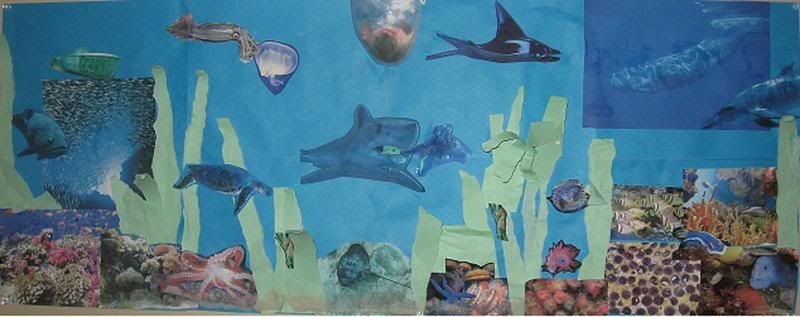
Here is the mural we made of ocean life. If you click it to enlarge you can look for 2 seahorses, a wolf eel, an octopus, a sea star eating scallops, 2 nudibronchs, sea urchins, sea anemones, a puffer fish, a moon jelly fish, a squid, a seal, a manta ray, a sting ray, a whale, a dolphin, a school of fish, a grouper, a sea turtle, coral, sea weed, real sand, a shark, a submarine and a very unlucky diver! Actual mural size is 17" x 44"

George and the Dragon

Here is an awesome stop motion video made by Catholic School kids for St. George's Day. We watched it after reading that dragon legends like this one may have originated from dinosaur encounters. What a concept!

Are Dinosaurs in the Bible?


Here is a funny little video that partly explains the Biblical belief that dinosaurs co-existed with man.

D is for Dinosaur


This is probably the lesson I was most excited about teaching so far. One of the main reasons I chose to home school was to be able to teach my children the truth of Biblical creation as a valid scientific approach. (Our words to remember were “Big and small, God made them all”.) In public schools, children are taught the theory of evolution as though it has been proven, and the concept of a million year old earth in spite of the very faulty dating processes used to come up with that idea. But the Bible’s teaching that the world is only about 6000 years old, combined with the account of Noah’s flood give a completely adequate explanation for dinosaurs, fossils, geological anomalies, etc. Obviously there isn’t room here, but check the CRI link at the end of this post if you are interested in more information.
We read a book from the Creation Research Institute called “What Really Happened to the Dinosaurs?” Then we checked out a book from the library called “Boy were we wrong about the dinosaurs!”, discussing how many of the theories once held about dinosaurs have been altered or completely thrown out as more clues surface. Then we looked at a picture book of dinosaurs and each child chose 2 dinosaurs to become “experts” on. They studied how big they were, what they ate, what their name meant and where their fossils have been found. We made models of dinosaurs from playdough as well as stuffed paper bag dinos. And Daddy surprised us by renting Jurassic Park for us to watch, just for fun!!! Even after that traumatic event, Ardara has decided she wants to be an archaeologist or an anthropologist when she grows up!

Click here for an article by Ken Ham of the Creation Research Institute. This article was turned into a really good kids book which we read for school. In it, he talks about a lot of evidence that dinosaurs lived at the same time as man. Legends of dragons are only the beginning. There were also glyphs found in Utah that look like dinosaurs. There were dinosaur bones found that are NOT fossilized. One account in the Amazon jungle is thought to be a dinosaur that is still living! Anyway, to that end, we also watched some funny little videos that will be posted after this.


Click here for a story about the petroglyph discovery - with photos like this one!

The Blend Ladder


The blend ladder is used to help the student read two and three-letter syllables. I begin by placing a textured letter on the ladder in front of a vowel we have learned. The child tells me the sound of that letter, then the sound of the vowel and then we blend the two sounds together. We climb the letter up and down the ladder to each vowel we have learned and see how the syllable changes. The next day, we add a letter after the vowel sound as well. And finally, we have a blend ladder worksheet to do. I tell the children a word and ask them to point to the vowel sound that is hiding in the middle of the word. For “sat” they will point to the /a/ at the top of the ladder. Then they have to figure out what letter is at the beginning and write it in and what letter is at the end and write it in. When the ladder is filled in, they practice writing the new words on lined writing paper.
The kids are using this new knowledge to read words all over the place—cereal boxes, seat belts and much more!